



On this page
Article III judges, bankruptcy judges, and magistrate judges work in federal courts across the country to ensure that caseload demands are met and that justice is delivered in a timely manner to all litigants.
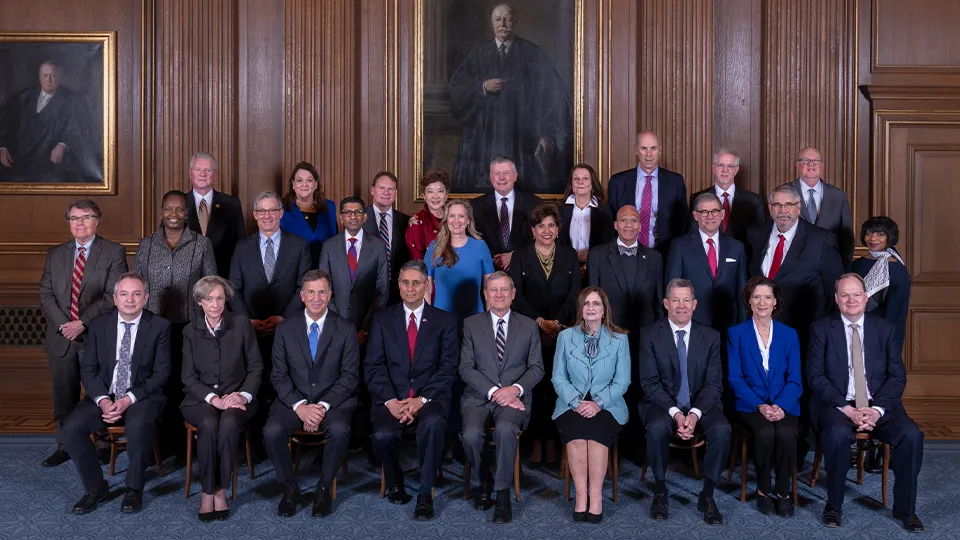
Membership of the Judicial Conference of the United States, March 2025
Seated (L to R): Chief Judge David Jeremiah Barron, Chief Judge Debra Ann Livingston, Chief Judge Michael A. Chagares, Chief Judge Albert Diaz, Chief Justice John G. Roberts, Jr., Chief Judge Jennifer Walker Elrod, Chief Judge Jeffrey S. Sutton, Chief Judge Diane S. Sykes, Chief Judge Steven M. Colloton.
Standing, second row (L to R): Judge William E. Smith, Chief Judge Margo K. Brodie, Chief Judge Mitchell S. Goldberg, Chief Judge Srikanth Srinivasan, Chief Judge Kimberly A. Moore, Chief Judge Mary H. Murguia, Chief Judge Jerome A. Holmes, Chief Judge William H. Pryor, Judge John Bailey, Chief Judge Debra M. Brown.
Standing, third row (L to R): Judge S. Thomas Anderson, Chief Judge Virginia M. Kendall, Chief Judge Roberto A. Lange, Judge Leslie E. Kobayashi, Judge William Paul Johnson, Judge Lisa Wood, Chief Judge James Emanuel Boasberg, Chief Judge Mark Barnett, Judge Robert J. Conrad, Jr., (Director of the Administrative Office of the U.S. Courts).
Article III Judgeships
The vast majority of federal judges are Article III judges, so named for the third article of the Constitution that created their positions in the early days of the republic. They include the nine justices on the Supreme Court, plus the circuit judges serving in 13 appellate courts, the district judges serving in 94 district-level trial courts, and the judges who serve on the U.S. Court of International Trade. In fiscal year (FY) 2025, there were 179 circuit judges, 673 district judges, and nine judges on the Court of International Trade. The court system has a shortage of Article III judges, and the Judicial Conference of the United States asked Congress in early 2025 to establish an additional 71 such judgeships.
Article III judges are appointed to lifetime terms after being nominated by the President and confirmed by the Senate, following a process established by Article III of the Constitution. They can be removed from office through the impeachment process. Congress has established additional federal courts and judgeships under Article I of the Constitution. They include U.S. magistrate judges and judges who serve in the territorial, federal claims, bankruptcy, and tax courts.
Article III Vacancies, Nominations, and Confirmations
As of December 31, 2025, there were 40 Article III judgeship vacancies: 39 in the district courts (17 of which were designated judicial emergencies) and one on the Court of International Trade. There were no vacancies in the courts of appeals or the Court of Federal Claims. In addition, nine future vacancies were announced (when a judge announces a retirement date), all in district courts. Eight Article III judgeship nominations were pending in district courts. During the first session of the 119th Congress (calendar year 2025), six circuit judges and 20 district judges were confirmed.
Senior Judges
In fiscal year (FY) 2025, 501 senior Article III judges served in the courts of appeals, the district courts, and the Court of International Trade, providing vital assistance in courts with large, sustained caseloads. Nationwide, during the 12 months ending September 30, 2025, senior judges participated in 20 percent of all courts of appeals cases that were terminated after oral hearing or submission on briefs. In the district courts, senior judges closed 14 percent of all criminal cases and civil cases that were terminated, and they conducted 26 percent of all completed trials.
Bankruptcy Judges
The Conference conducts assessments of the circuits every two years to gather information about where additional bankruptcy judgeships are needed. The assessments examine each court’s workload and case filing statistics, geographic needs, and other relevant factors that the Conference uses in drafting its requests to Congress for additional judgeships, conversions of temporary judgeships to permanent status, and extensions of temporary judgeships.
Congress has created temporary bankruptcy judgeships to address immediate workload needs when it is reluctant to establish permanent judgeships. Of the 345 total bankruptcy judgeships currently authorized by law, 29 are temporary. A temporary judgeship is typically authorized for five years from the day a judge is sworn into office.
In September 2025, the Conference asked Congress to convert seven temporary bankruptcy judgeships to permanent status (all in the District of Delaware) and extend 11 temporary bankruptcy judgeships for an additional five years — two each in the Eastern District of Michigan and Southern District of Florida, and one each in the Middle District of Florida, District of Maryland, District of Nevada, District of New Jersey, Eastern District of North Carolina, District of Puerto Rico, and District of South Carolina.
Magistrate Judges
Magistrate judges perform indispensable work for the Judiciary. In FY 2025, there were 563 full-time magistrate judges serving the Judiciary. There were also 25 part-time magistrate judge positions, two combination clerk of court/magistrate judge positions, and 82 retired magistrate judges serving on recall, with several authorized to serve in multiple districts.
During the 12 months ending September 30, 2025, magistrate judges accomplished the following:
- Conducted 576,876 felony preliminary proceedings, including search warrants, initial appearances, detention hearings, preliminary proceedings, and arraignments. They also disposed of Class A misdemeanor and petty offense cases involving 49,465 defendants.
- Disposed of 17,364 civil cases with the consent of the parties and conducted 20,597 settlement conferences in civil cases.
Visiting Judges
Visiting judges are judges from one court who serve on a temporary basis in another court. They provide short-term assistance to courts with high caseloads and other workload issues, including recusals. The work of visiting judges is facilitated by the Judicial Conference’s Committee on Intercircuit Assignments.
In FY 2025, the committee recommended, and the Chief Justice approved, 188 intercircuit assignments of Article III judges. The committee also reviewed and concurred with 12 intercircuit assignments of magistrate judges and 13 intercircuit assignments of bankruptcy judges. For the 12 months ending September 30, 2025, visiting judges accomplished the following:
- Visiting Article III judges participated in 1,433 appeals closed after an oral hearing or on briefs. They closed 683 civil cases and closed matters involving 893 criminal defendants.
- Visiting magistrate judges terminated one civil case with the consent of the parties.
- In the bankruptcy courts, visiting judges provided 3,961 hours of assistance.
Biannual Meetings of the Judicial Conference
The Judicial Conference of the United States is the national policy-making body for the federal Judiciary. The Chief Justice is the presiding officer. In 2025, the Conference met on March 11 and on September 16 at the Supreme Court in Washington, DC. Reports of the Conference’s meetings are published on the Judiciary’s website.
New Judicial Conference Committee Chairs
The Judicial Conference committees make policy recommendations to the Conference in a variety of areas, including the budget, court administration, defender services, IT, probation and pretrial services, rules of practice and procedure, security, and space and facilities. The Chief Justice has sole authority to make committee appointments.
The Executive Committee is the senior executive arm of the Conference, with responsibilities that include acting on behalf of the Conference between sessions on matters requiring emergency action and preparing proposed consent and discussion calendars for Conference meetings. Sixth Circuit Chief Judge Jeffrey S. Sutton chaired the Executive Committee in 2025.
In 2025, Chief Justice John G. Roberts Jr. named five new chairs of Judicial Conference committees and extended the terms of five current chairs by one year. The appointments took effect October 1:
- Judge Gregory F. Van Tatenhove (Eastern District of Kentucky) was extended for one year as chair of the Committee on Court Administration and Case Management.
- Judge Michael Y. Scudder (Seventh Circuit) was extended for one year as chair of the Committee on Information Technology.
- Chief Judge Stephen J. Murphy III (Eastern District of Michigan) succeeded Judge Nicholas G. Garaufis (Eastern District of New York) as chair of the Committee on Intercircuit Assignments.
- Judge David G. Campbell (District of Arizona) was extended for one year as chair of the Committee on International Judicial Relations.
- Judge Timothy M. Tymkovich (Tenth Circuit) succeeded Judge William B. Traxler, Jr. (Fourth Circuit) as chair of the Committee on Judicial Conduct and Disability.
- Judge Richard J. Sullivan (Second Circuit) was extended for one year as chair of the Committee on Judicial Security.
- Judge James C. Dever III (Eastern District of North Carolina) succeeded Judge John D. Bates (District of Columbia) as chair of the Committee on Rules of Practice and Procedure.
- Bankruptcy Judge Rebecca Connelly (Western District of Virginia) was extended for one year as chair of the Advisory Committee on Bankruptcy Rules.
- Judge Sarah S. Vance (Eastern District of Louisiana) succeeded Judge Robin L. Rosenberg (Southern District of Florida) as chair of the Advisory Committee on Civil Rules.
- Judge Michael W. Mosman (District of Oregon) succeeded Judge James C. Dever III (Eastern District of North Carolina) as chair of the Advisory Committee on Criminal Rules.
Annual Report 2025
- Annual Report 2025
- Funding and Budget
- The Courts and Congress
- The Federal Bench
- Accountability and Resource Management
- Public Outreach and Communications
- Facilities and Security
- Court Operations
- Defender Services
- Probation and Pretrial Services
- Human Resources
- Information Systems and Cybersecurity
- Recent and Proposed Amendments to Federal Rules
- In Profile