


On this page
Federal judges and court staff conducted a variety of public outreach and communications efforts to improve public understanding of the Judiciary’s role in American democracy.
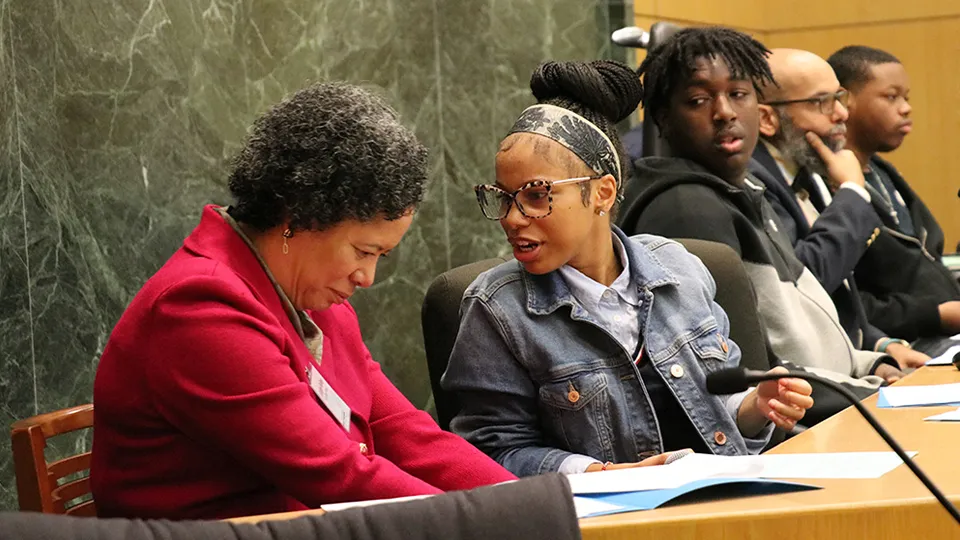
Seated on the bench, U.S. District Judge Angel Kelley, left, confers with a student during oral arguments on the First Amendment at a civics program in a Washington, DC, courtroom.
Civics Education and Outreach Programs Held Around the Country
Court-sponsored civics education programs in 2025 were conducted for a wide range of age groups, from high school to adult levels. The Administrative Office of the U.S. Courts (AO) offered a portfolio of programs and resources to meet the courts’ objectives.
Student education opportunities included court camps, after-school classes, fellowship programs, courtroom simulations that teach civil discourse skills, and school visits called Candid Conversations. The learning objectives are to build confidence in the courts and to make participants aware of a range of Judiciary career paths. Open Doors to Careers in the Courts is a national initiative that connects students with the federal Judiciary and careers in the courts, seeking to inspire the next generation of court professionals.
Teachers’ professional development opportunities allowed educators to go behind the scenes at courthouses to interact with judges and attorneys in participatory courtroom simulations. Student-relevant topics for these realistic hearings ranged from social media controversies to cell phone bans to student protests. In addition, a new initiative supported teachers by placing law students in high school classrooms to teach the Constitution.
Adult education opportunities were offered by courts at community colleges and lifelong learning programs across the nation. They heightened awareness of the value of the rule of law, separation of powers, judicial impartiality, and other pillars of court literacy and were taught by judges, lawyers, and court professionals. A range of formats were offered through national networks, some of which are affiliated with colleges and universities. Judges facilitated the highly interactive programs.
The AO also continued to support national and circuit conferences on civics education and the courts throughout 2025. The meetings brought together key stakeholders inside and outside of the courts to discuss programs and resources that can be customized and scaled to match the capabilities of courts with the needs and interests of their communities.
The federal courts’ second national civics conference was hosted in St. Louis as a follow-up to the first systemwide conference in 2019. The Honorable Robert A. Katzmann Conference on Civics Education and the Federal Courts brought together judges; court personnel; and representatives of civics education organizations, bar associations, and academic communities from across the nation to discuss current and future initiatives.
At the circuit level, the Ninth, Sixth, and Second Circuits each hosted a circuit-wide meeting to share programs, resources, and aspirational goals. The Ninth Circuit attracted broad participation by offering the conference online. The Sixth Circuit included judges, court staff, and attorneys in a civics conference to raise awareness of effective initiatives and identify ways to enhance and grow outreach. The Second Circuit partnered with New York Law School in a joint venture to promote civics education.
Assisted by the AO’s video communication specialists, the U.S. Court of Appeals Federal Circuit offered students a unique, hands-on experience during its Innovation Day. Students participated in a mock trial, explored historic houses, and engaged with interactive exhibits that tested their analytical skills. The visit also included the opportunity to meet a federal judge, giving students a look at how the courts connect to real-world problem-solving.
Improving Web Communication
Early in 2025, the AO launched a newly redesigned and enhanced public website, uscourts.gov, as part of an ongoing effort to modernize the Judiciary’s public-facing websites using updated technology. The updated site was the first step in offering increased accessibility for all users, enhanced functionality, and new information resources to the public. The website is the primary online resource for information on the structure and function of the federal court system, as well as Judiciary data, news, and policy, and access to other Judiciary sites and systems.
The next phase of the modernization effort began in March 2025, and was focused on enhancing over 250 individual court unit websites to increase accessibility, content, and site functionality. Each court site offers the public resources specific to the work of that court, including local rules and orders, calendars, pro se filing information, and courthouse location and access details, as well as basics about the federal Judiciary.
Annual Report 2025
- Annual Report 2025
- Funding and Budget
- The Courts and Congress
- The Federal Bench
- Accountability and Resource Management
- Public Outreach and Communications
- Facilities and Security
- Court Operations
- Defender Services
- Probation and Pretrial Services
- Human Resources
- Information Systems and Cybersecurity
- Recent and Proposed Amendments to Federal Rules
- In Profile