


On this page
Committed to efficiency, safety, and cost containment, the Judiciary responds in a coordinated way to security issues and emergencies while also working with the General Services Administration (GSA) to replace outmoded courthouses with modern, secure facilities.
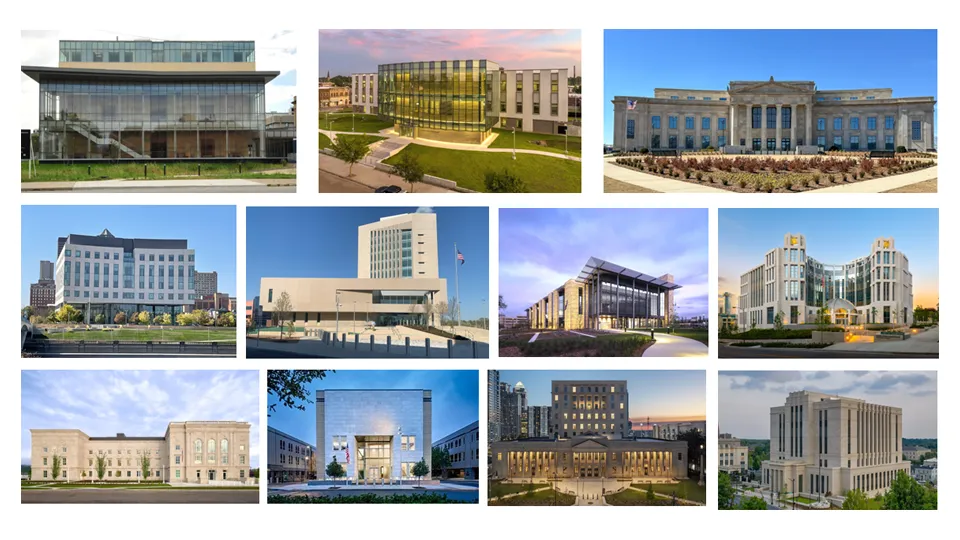
A look at some of the courthouse construction projects undertaken in recent years. The projects are in (top row, L to R) Toledo, OH; Greenville, MS; Huntsville, AL; (middle row, L to R) Des Moines, IA; Harrisburg, PA; San Antonio, TX; Nashville, TN; (bottom row, L to R) Anniston, AL; Savannah, GA; Charlotte, NC; and Greenville, SC.
Judicial Security and Vulnerability Management
The Judiciary’s Vulnerability Management Program for judges and their families experienced significant growth in 2025 amid a heightened level of threats against federal judges and their families. There were also mass gatherings near courthouses and direct threats against Judiciary executives. The program, begun in late 2022, was the Judiciary’s response to mounting security issues.
Approximately 80 percent of sitting judges, as well as more than 100 retired judges and 1,200 qualified family members, are now enrolled in the Judiciary’s Personally Identifiable Information (PII) Reduction and Redaction Program. The program assesses the online presence of PII across social media platforms, data brokers, dark websites, open web sources, and public records sites. It also provides staffing support to program enrollees to assist them in facilitating the removal of PII, such as a judge’s home address, from these sources.
The Administrative Office of the U.S. Courts (AO) has also increased collaboration with the U.S. Marshals Service, an arm of the Department of Justice and the main government entity providing security for judges and their families. The AO’s Judiciary security officers in each circuit have also fostered greater collaboration between the AO and its executive branch judicial security providers.
Courthouse Security
Enhancing security for judges, court staff, and the public at courthouses has been a major focus for the Judiciary after Congress allocated $127.5 million for such court-based security measures in 2022. An interagency group established by the AO consists of representatives from the U.S. Marshals Service, the Federal Protective Service (FPS), and the General Services Administration (GSA). The group’s goal is to harden and better protect courthouse buildings.
As of September 2025, the AO had committed nearly $97.4 million to the GSA to design and construct security countermeasures to prevent hostile crowds from forcibly entering doors and windows at court facilities. Sixty-three facilities had been allocated funding for design services, 11 of which were in the construction phase for security enhancements. Three projects were completed.
These security measures involve a variety of physical enhancements, including window replacements, reinforced windows, and roll-down doors. Each building is evaluated for needed countermeasures, taking into account historical and public safety concerns.
In addition, $5 million was transferred to the FPS in 2022 for temporary fencing that can be used on the perimeter of court facilities for high-profile trials or periods of civil unrest. There were four successful deployments of temporary fencing at courthouses.
New Courthouse Construction
The AO is managing and supporting multiple projects that are part of a $2 billion commitment by Congress for courthouse construction around the country over the past 10 years.
In progress in 2025 were new courthouse building projects in Greenville, MS; Fort Lauderdale, FL; San Juan, PR; Chattanooga, TN; and Hartford, CT. Also underway were significant courthouse modernization projects in Toledo, OH (Ashley) and Savannah, GA (Tomochichi).
The Chattanooga project was in the design phase and the Hartford project was in final stages of programming. Both were conducting site acquisition activities. The San Juan project is an annex that was in the design phase; it is a key part of the new plan for the Hato Rey Federal Court Complex, which is considered a judicial space emergency due to seismic risks.
Future courthouse projects include buildings in Bowling Green, KY; Anchorage, AK; and McAllen, TX.
The federal courthouse construction program is administered jointly by the Judiciary and the GSA. The Judiciary establishes priorities for courthouse construction projects and sets the requirements for each project to ensure that completed facilities meet the needs of the courts. The GSA secures the funding for construction, acquires the building sites, and completes design and construction work on the facilities. The Judiciary annually identifies potential locations for new courthouses and annexes and prioritizes major renovations of courthouses that have the most urgent needs.
Emergency Management
The AO provides emergency management awareness and support to the federal courts through policy guidance, resources, training, and incident support initiatives. In 2025, the AO coordinated support to the Western District of North Carolina in response to Hurricane Helene and to the Central District of California in response to wildfires in the Los Angeles area.
Workshops were conducted for courts across the nation to enhance collaboration with federal, state, and local agency partners and to bolster resilience and emergency preparedness. In addition, education programs focused on active shooter preparedness for the Judiciary.
Annual Report 2025
- Annual Report 2025
- Funding and Budget
- The Courts and Congress
- The Federal Bench
- Accountability and Resource Management
- Public Outreach and Communications
- Facilities and Security
- Court Operations
- Defender Services
- Probation and Pretrial Services
- Human Resources
- Information Systems and Cybersecurity
- Recent and Proposed Amendments to Federal Rules
- In Profile