



On this page
Congress appropriates funds for the Judiciary to carry out its constitutional duties and also provides funds to the General Services Administration for courthouse construction and maintenance. The Judiciary is committed to spending public funds in a responsible and cost-efficient way.
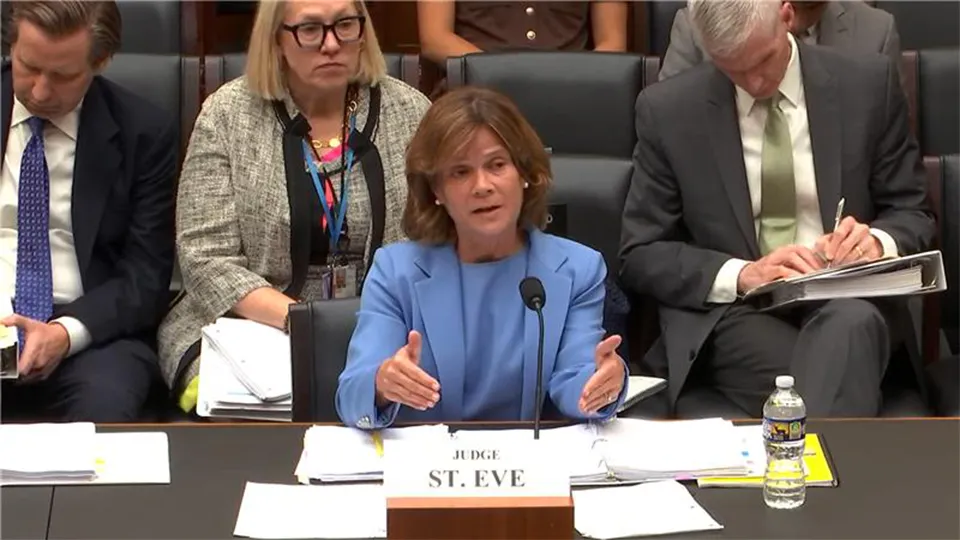
Seventh Circuit Judge Amy J. St. Eve, chair of the Judicial Conference’s Budget Committee, describes the Judiciary’s critical funding needs at a hearing of the House Appropriations Subcommittee on Financial Services and General Government.
Fiscal Year 2026 Funding Request and Lapse in Appropriations
In April 2025, the Judiciary’s budget request to Congress for fiscal year (FY) 2026 totaled $9.4 billion in discretionary appropriations, a 9.3 percent ($800 million) increase over its FY 2025 appropriation. The increase was necessary to help the Judiciary recover from two straight years of flat funding and to ensure that it could continue its essential constitutional functions.
“More than half of the branch’s accounts are operating … on funding levels that have not been adjusted since FY 2023,” Seventh Circuit Judge Amy J. St. Eve, chair of the Budget Committee of the Judicial Conference of the United States, said in testimony to Congress.
“An effective and efficient Judiciary is foundational to the system of government envisioned by our founders,” she said. “Adequate and consistent funding is absolutely critical to the conduct of those responsibilities.”
Judge St. Eve pointed out that funding shortages were especially critical for defender services. Federal defender organizations were operating under a hiring freeze, and, due to insufficient funding in FY 2025, voucher payments to court-appointed private defense lawyers were suspended in July, nearly three months before the end of the fiscal year, leaving defense attorneys around the country working on cases without pay. The suspension lasted more than five months, until the lapse in appropriations was resolved in mid-November.
“These disruptions in panel attorney payments negatively affect our panel attorneys,” Judge St. Eve said, “potentially reducing their willingness to accept future appointments and jeopardizing the ability to provide necessary and timely representation.”
Consecutive years of flat funding also strained the account providing adequate security for judges and courthouses, Judge Robert J. Conrad Jr., Director of the Administrative Office of the U.S. Courts, told Congress. Throughout 2025, there were mounting incidents of physical threats and public attacks on judges for decisions they made.
“The independence of the judicial branch is jeopardized when judges are threatened with harm or impeachment for their rulings,” Judge Conrad said. “Our constitutional system depends on judges who can make decisions free from threats and intimidation. This is essential not just for the safety of judges and their families, but also to protect our democracy.”
The start of the FY 2026 appropriations process was delayed for multiple reasons, including intensive focus by lawmakers on the budget reconciliation process that culminated in the enactment of President Trump’s One Big Beautiful Bill. The delays constrained the House and Senate Appropriations Committees’ ability to begin work on the FY 2026 appropriations bills.
In November, the Judiciary submitted a reestimated FY 2026 budget request to Congress seeking $9.4 billion in appropriations, a 9.1 percent ($787 million) increase over FY 2025, and $13 million below the original budget request.
Judiciary funding is included in the Financial Services and General Government appropriations bill. The House version of the bill, approved by the Appropriations Committee in September, provided the Judiciary with $8.9 billion in discretionary appropriations, a 3.5 percent ($306 million) increase above the FY 2025 enacted level but $481 million below the Judiciary’s reestimate request. The Senate Appropriations Committee’s version of the bill, released by the committee in November, provided the Judiciary with $9 billion in discretionary appropriations, a 4.8 percent ($414 million) increase above the FY 2025 enacted level and $373 million below the Judiciary’s reestimated request.
The 12 annual appropriations bills for FY 2026 were not enacted into law before the start of the fiscal year. With the two national political parties unable to agree on a continuing resolution to keep the government running, the longest shutdown in U.S. federal government history began on October 1.
The Judiciary was able to continue paid operations through October 19, using court fee balances and other funds not dependent on a new appropriation. On Monday, October 20, as the stalemate continued, the judicial branch ceased full, paid operations. Federal courts maintained limited operations necessary to perform the Judiciary’s constitutional functions.
Federal judges continued to serve, in accordance with the Constitution, but court staff were able to perform only certain excepted activities under the Antideficiency Act. Examples of excepted work included activities necessary to perform constitutional functions under Article III, activities necessary for the safety of human life and protection of property, and activities otherwise authorized by federal law. Personnel not performing excepted work were furloughed. Each appellate, district, and bankruptcy court made operational decisions regarding how its cases and probation and pretrial supervision would be conducted during the shutdown.
After Congress enacted a continuing resolution that extended government funding through January 30, 2026, the judicial branch returned to full paid operations on November 13, 2025. As the year ended, the very real threat of a second government-wide shutdown loomed on the horizon.
Highlights of the Judiciary’s discretionary reestimated request for FY 2026 included the following:
- $6.3 billion for the Salaries and Expenses account, which funds most court operations — a 5.6 percent ($337 million) increase over the FY 2025 level. More than $256 million of the increase was needed just to maintain current service levels, with the remainder dedicated to spending related to new workload, infrastructure priorities, and improved administrative and managerial controls, Judge St. Eve said in her congressional testimony.
- $1.8 billion for the Defender Services account, a 21.2 percent ($308 million) increase over the FY 2025 hard-freeze level. This included funding to cover the deferred payments to attorneys in FY 2025. The requested level would also enable federal defender organizations to begin hiring staff after a year-long hiring freeze.
- $892 million for the Court Security account, an 18.9 percent ($142 million) increase over the FY 2025 enacted level. About $91 million would go toward critical systems and equipment needs, including emergency management equipment, vehicle barriers and mobile guard booths, radios, and screening equipment, as well as video systems for monitoring all areas of a courthouse.
The Judiciary’s FY 2026 appropriations request also included $872.4 million in mandatory appropriations for the salaries and benefits of judges as well as retirement costs for judges and their survivors.
Fiscal Year 2025 Funding
In March 2025, the President signed into law the Full-Year Continuing Appropriations and Extensions Act, 2025, which included FY 2025 funding for the Judiciary. The legislation held the Judiciary to its FY 2024 enacted appropriation level, with $8.6 billion in discretionary appropriations. The Judiciary had asked for $9 billion for FY 2025, a 4.5 percent increase over the FY 2024 level.
The following are highlights of the Judiciary’s 2025 financial plan, which, in addition to appropriations, included funds derived from fee collections and available balances:
- $7.1 billion for the Salaries and Expenses account, which pays for court salaries and general operating expenses. Included was $94.2 million for the Judiciary’s multi-year cybersecurity and IT modernization plan. Among the projects were modernization of the Probation and Pretrial Services Automated Case Tracking System, eVoucher, and the Judiciary Integrated Financial Management System.
- $1.5 billion for the Defender Services account, which includes salaries and operating expenses for federal defender organizations and payments to Criminal Justice Act panel attorneys, defense attorneys appointed by the courts. As a result of budget constraints, panel attorney funding was depleted on July 3, 2025, and payment of vouchers was deferred until additional appropriations could be secured. In addition, federal defender organizations were under a hiring freeze for nearly the entire fiscal year.
- $832.7 million for the Court Security account, which included $55.9 million for courthouse hardening to protect court facilities from attempts to disrupt the judicial process. Also included were $545 million for court security officers, $93.2 million for Federal Protective Service–provided security, and $133.6 million for security systems and equipment, which included $12.2 million for the Vulnerability Management Program to help judges and their family members identify and address threats to their security.
- $49.1 million for the Fees of Jurors and Commissioners account, allowing the Judiciary to fund petit juror and grand juror requirements in FY 2025.
Budget Constraints and Congressional Outreach
As budget constraints strained Judiciary operations in FY 2025, Judiciary leaders and individual judges made repeated overtures to Congress for relief. The majority of the federal court system’s accounts were flat funded for two consecutive years, with uncertain budget prospects for FY 2026.
Judge St. Eve delivered a grim budget report to the Conference at its September 2025 meeting, saying that the Judiciary could receive $800 million less than requested from Congress in the new fiscal year.
By that time, the Judiciary had already deferred payments to hundreds of defense attorneys until additional appropriations became available from Congress. In June, Judge St. Eve and Judge Michael Y. Scudder, IT Committee chair, testified at a congressional hearing that the Judiciary’s ability to continue momentum on cybersecurity and IT modernization was wholly reliant on sufficient and consistent funding for these high-priority initiatives.
Steep cuts to funding for court staffs and centrally managed programs were anticipated as well if the Judiciary was held to another full-year hard-freeze continuing resolution in FY 2026. Critical programs to protect judges and courthouses were also jeopardized at a time of mounting security threats.
Judiciary leaders advocated strongly for full funding of its budget requests. In addition, outreach efforts by courts nationwide to local congressional delegations focused on the impacts of budget constraints on critical services, such as providing defense counsel, public safety, and the security of judges and courthouses.
Annual Report 2025
- Annual Report 2025
- Funding and Budget
- The Courts and Congress
- The Federal Bench
- Accountability and Resource Management
- Public Outreach and Communications
- Facilities and Security
- Court Operations
- Defender Services
- Probation and Pretrial Services
- Human Resources
- Information Systems and Cybersecurity
- Recent and Proposed Amendments to Federal Rules
- In Profile