



On this page
Probation and pretrial services officers strive to achieve positive changes in individuals under supervision while also protecting the community. Using evidence-based practices and innovative technology, these officers focus on the efficient use of limited resources to maintain public safety and reduce recidivism.
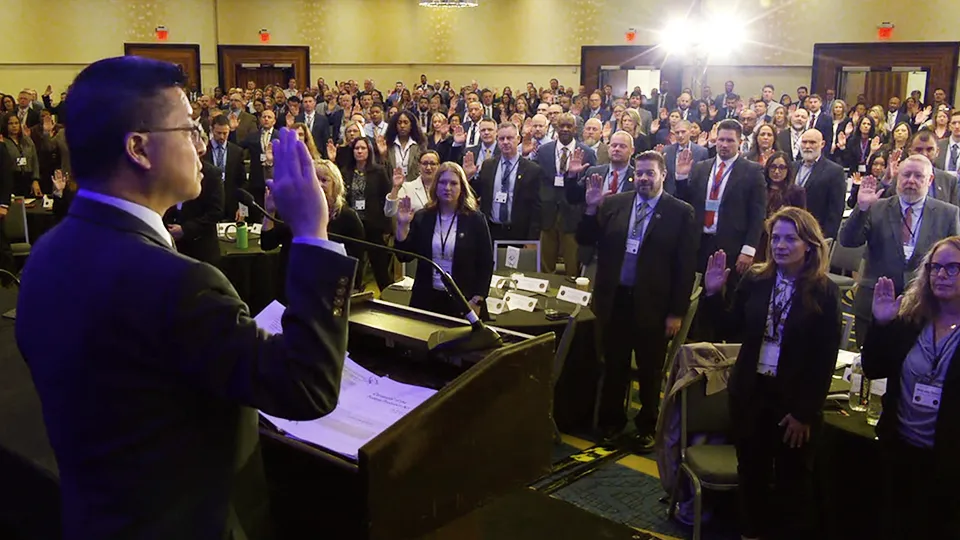
Probation and Pretrial Services officers reaffirm their oath of office during a special celebration of the 100th anniversary of the federal Probation Act in March 2025.
The Federal Probation Act Centennial
On March 4, 2025, the Judiciary celebrated the 100th anniversary of the Probation Act of 1925.
Signed by President Calvin Coolidge, the legislation allowed federal judges to sentence defendants to terms of probation in lieu of imprisonment for the first time and resulted in the creation of the federal probation system. The probation system was initially administered by the Department of Justice. Then in 1939, Congress created the Administrative Office of the U.S. Courts (AO) to provide independent administration of the courts, and the probation system was transferred to the federal Judiciary.
In the years following its creation, the federal probation system grew significantly. Pretrial Services was created by Congress in 1982. Then, in 1987, the initial version of the Sentencing Guidelines Manual went into effect, and probation officers were tasked with implementing a new federal sentencing system, which included managing the terms of supervised release.
In 2025, the probation and pretrial services system had about 7,600 employees. Its officers and staff play important roles in promoting the fair administration of justice by conducting comprehensive pretrial and presentence investigations; preparing timely and accurate bail and presentence reports; and providing judges with impartial, evidence-based recommendations. Probation and pretrial services officers also play a vital role in protecting communities by enforcing court-ordered conditions of supervision and by providing and arranging services designed to reduce recidivism.
PACTS360 Reaches Major Milestone
The AO completed development of a new Probation and Pretrial Services Automated Case Tracking System (PACTS360), a major initiative that modernizes the main case management system used by probation and pretrial services officers in their supervision and investigative efforts. PACTS360 provides a single database for all case and client records, from pretrial interviews and bail reports to presentence investigations and supervision, and facilitates greater data sharing among offices nationwide.
Pilot courts will launch in 2026, with nationwide implementation in all 94 districts expected the following year. PACTS360 will replace the current aging system with a highly configurable cloud-based system that is more efficient and more secure. It will provide access to the enterprise data warehouse for improved operational and analytical reporting.
Academy Earns Accreditation
The Federal Probation and Pretrial Academy earned full academy accreditation from the Federal Law Enforcement Training Accreditation (FLETA) Board in May 2025, in recognition of the high professional standards of its training programs.
The academy is one of only 16 FLETA-accredited federal law enforcement academies; peers include training programs serving the U.S. Drug Enforcement Administration, the U.S. Secret Service, and the U.S. Marshals Service. The academy, located in Charleston, SC, provides initial training for newly appointed officers and advanced instruction in firearms, officer safety, and search and seizure. The academy’s Initial Probation and Pretrial Training course was accredited earlier, and now the board has awarded full academy accreditation.
FLETA accreditation, which must be renewed every five years, requires an independent review of training programs to ensure compliance with standards in administration, staff qualifications, training development, and training delivery. This distinction underscores the academy’s commitment to evidence-based, high-quality officer training.
Preparation for Amendments to Sentencing Guidelines
The Judicial Conference Committee on Criminal Law and AO staff worked closely with the U.S. Sentencing Commission on amendments to the U.S. Sentencing Guidelines. The committee and AO staff specialists participated in a series of meetings hosted by the commission, and the committee chair also testified at public hearings held on the amendments.
Ahead of the November 1, 2025, effective date of the amendments to the guidelines, AO staff updated Judiciary policies, forms, and procedures to align with the changes, including revisions to the Guide to Judiciary Policy and probation and pretrial services manuals. Staff also secured Judicial Conference approval of updated Statement of Reasons forms and partnered with the commission to deliver nationwide probation officer training.
The adopted amendments encourage individualized assessments in supervised release, refine drug trafficking penalties, address the harms of fentanyl “fake pills,” establish penalties for machine-gun conversion devices, simplify the guideline application process, and resolve circuit conflicts.
Annual Report 2025
- Annual Report 2025
- Funding and Budget
- The Courts and Congress
- The Federal Bench
- Accountability and Resource Management
- Public Outreach and Communications
- Facilities and Security
- Court Operations
- Defender Services
- Probation and Pretrial Services
- Human Resources
- Information Systems and Cybersecurity
- Recent and Proposed Amendments to Federal Rules
- In Profile